Product Detail
Bandpass Filter
Related Products
- BP405nm bandwidth 20nm bandpass filter
- BP400nm bandwidth 20nm bandpass filter
- Dual bandpass 497nm 655nm filter
- BP380nm bandwidth 20nm bandpass filter
- BP385nm bandwidth 65nm bandpass filter
- BP395nm bandwidth 20nm bandpass filter
Custom Order
 15112422758
Call / Send specs for a quote
Custom to Drawing or Sample
Send us wavelength, size and coating specs — or a drawing or sample — and we will evaluate and issue a proposal. Prototype samples in 3-7 working days.
Scan to chat with us
Technical Specifications
Specifications for this model are coming soon — call us for measured data.
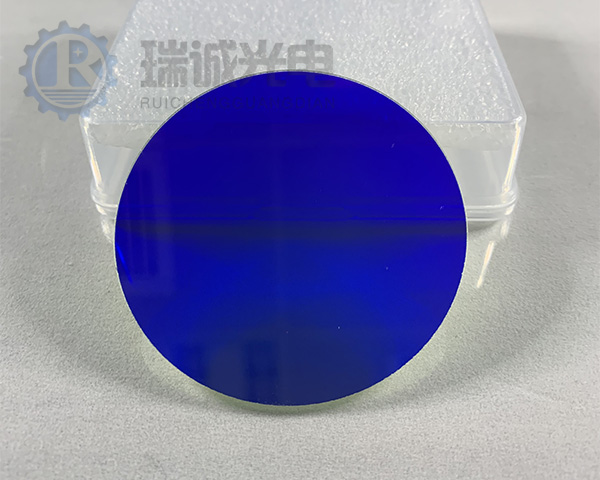
A bandpass filter only allows light to pass through within the allowable range. The specific structure is as follows: a semi transparent metal layer is coated on a glass substrate, followed by a magnesium fluoride barrier layer, and then a semi transparent metal layer. These two metal layers form a Fabry Perot standard tool with two parallel plates. When the distance between the two poles is of the same order of magnitude as the wavelength, the interference peaks of different wavelengths in the transmitted light will be very separated. By using other absorption filters, unacceptable light can be filtered out, thus obtaining the specified bandpass filter plate. The passband of bandpass filters is much narrower than that of ordinary absorption filters, and there are also all dielectric filters. Two typical structures are as follows: the passband of bandpass filters can range from infrared to ultraviolet according to needs. In the visible region, bandpass filters can be used to segment images into different colors in the visible light region.
Optical specifications:
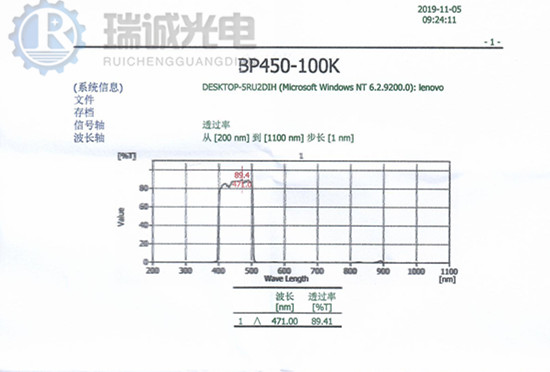
Center wavelength:; 450nm± three
Bandwidth: 100nm (customizable base bandwidth)
Cut-off area: 200nm-400nm,500nm-1100nm
Minimum transmittance: T>92%
Cut off depth: OD4 (customizable according to customer needs)
Substrate material: Colored glass, Schott, B270, JGS1 (can be used according to customer requirements, meets environmental RoHS requirements)
Product size: 60X60mm (can be customized as square/round according to customer requirements)
Packaging: Dust free and anti-static vacuum packaging
Product Features:
Imported ultra-thin optical glass has good PV value, high permeability, small thickness tolerance, and good smoothness. It is coated by magnetron sputtering using imported coating equipment, which has the characteristics of high hardness, good spectral uniformity, and strong center wave stability.
Actual measured spectral curve:
Optical specifications:
Center wavelength:; 450nm± three
Bandwidth: 100nm (customizable base bandwidth)
Cut-off area: 200nm-400nm,500nm-1100nm
Minimum transmittance: T>92%
Cut off depth: OD4 (customizable according to customer needs)
Substrate material: Colored glass, Schott, B270, JGS1 (can be used according to customer requirements, meets environmental RoHS requirements)
Product size: 60X60mm (can be customized as square/round according to customer requirements)
Packaging: Dust free and anti-static vacuum packaging
Product Features:
Imported ultra-thin optical glass has good PV value, high permeability, small thickness tolerance, and good smoothness. It is coated by magnetron sputtering using imported coating equipment, which has the characteristics of high hardness, good spectral uniformity, and strong center wave stability.
Actual measured spectral curve: