Further discussion on the principle and types of filter light
In the past, optical filters were mainly used in the field of microscopes. With the rapid development of high-quality manufacturing in China, the application of optical filters has become increasingly widespread. As a result, the workforce is also expanding. Ruicheng Optoelectronics Thermal Column welcomes friends who are willing to work in the optical industry to join our team, with excellent treatment.
Classification method of filter:
Filter can be divided into TIRF filter, interference filter, total internal reflection filter, Raman filter, Raman filter, FISH fluorescence filter, and in situ hybridization filter according to different usage purposes.
According to their different functions, they can be divided into excitation filter, emission filter, dichroic mirror/dichroic filter/dichroic mirror, notch filter, fuel filter, fluorescent filter, ND filter, neutral filter, neutral grayscale mirror, cut-off filter, high pass filter, low-pass filter, band-pass filter, ultraviolet filter, and UV filter.
According to their main application areas, filters can be divided into biological filters, medical filters, and astronomical filters. Ruicheng Optoelectronics can provide various types of filters. For details, please contact Ruicheng Optoelectronics customer service personnel.
Fluorescence Filters
Mainly used in the fields of life sciences and biomedical sciences, its function is to separate and select the characteristic spectral bands of excitation light and emission fluorescence of substances in biomedical fluorescence detection and analysis systems.
Neutral grayscale mirror ND filter
A neutral density filter, also known as a medium gray density filter, is used to uniformly filter light. This filtering effect is non selective, which means that the ND mirror has the same and uniform ability to reduce light of different wavelengths, without affecting the color of the original object, and can truly reproduce the contrast of the scene.
Fluorescence in situ hybridization filter and FISH filter
Fluorescence in situ hybridization (FISH) is a technique that uses fluorescently labeled specific oligonucleotide fragments as probes to hybridize with DNA molecules in the environmental genome based on the population specific DNA sequences of known microorganisms at different taxonomic levels, in order to detect the presence and abundance of the specific microbial population.
Notch filter, Notch filter
Notch filters are commonly used for Raman spectroscopy testing. It is also commonly referred to as a band stop or band suppression filter. It can transmit the vast majority of wavelengths, but attenuate light within a specific wavelength range (stopband) to very low levels.
Total Internal Reflection Filter, TIRF Filter, Total Internal Reflection Fluorescence Filter
Used for total internal reflection fluorescence microscopy, it uses the latent waves generated by total internal reflection to illuminate the sample, limiting the illumination area to a thin layer on the surface of the sample, thus observing very imperceptible phenomena.
Characteristics of excellent filters:
Match the excitation peak and emission peak of the fuel with minimal overlap
Cut off depth deep
Low spontaneous fluorescence
Good lens surface shape facilitates the extraction of fluorescence imaging. If the flatness of the lens surface is poor, wavefront torque or wedge angle will be generated, which will change the focusing or imaging position. Generally, the transmitted wavefront torque (TWD) is greater than the reflected wavefront torque
The impact of RWD on imaging is more direct and will have stricter requirements.
The principle of filter:
Fluorescent filters generally use a single piece of colorless and transparent glass as the substrate, with coatings on both surfaces of the glass. The thickness of the anti reflection film will be selected as an integer multiple of half the wavelength, which enhances the reflection superposition; The thickness of the anti reflective film is a multiple of 1/4 wavelength, at which point the projection superposition is enhanced.
Excitation and imaging methods of filter
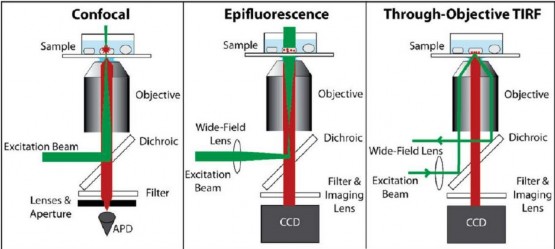
The excitation and imaging methods of fluorescent filters can be roughly divided into the following three types: focusing type: the incident excitation light is focused on the sample to be tested;
Wide field type: the incident excitation beam hits the sample over a larger area
Total Internal Reflection Type (TIRF): Excitation light passes through the sample to observe evanescent wave imaging
Filter sets and filter boxes
Filters are generally used in the form of filter groups in practice. The fluorescence filter group generally consists of three lenses: excitation filter (EX), dichroic mirror, and emission filter (EM), all of which are placed in the filter box (Cube). The specific structure is shown in the following figure,
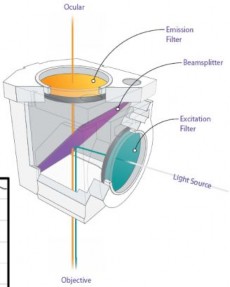
The function of a laser filter is to enable the excitation light to pass through effectively, while avoiding external fluorescent light from entering the filter box. The main function of a dichroic mirror is to split the light, reflect the laser to irradiate the sample, and also allow the fluorescence generated by the sample to pass through, achieving the emission filter. The function of the emission filter is to further filter out the excitation light and other stray light, so that the system obtains a relatively pure fluorescence signal.
Selection of filter
How to choose the appropriate filter is a problem that researchers need to consider during the project process. Ruicheng Optoelectronics provides fast and accurate selection support for you. Please contact Ruicheng Optoelectronics' technical personnel.
The principle for selecting fluorescence filters is to allow fluorescence/emission light to pass through as much as possible at the imaging end, while completely blocking excitation light, in order to achieve the highest signal-to-noise ratio. Especially for the application of multiphoton excitation and total internal reflection microscopy, weak noise can also cause significant interference to the imaging effect, thus requiring higher signal-to-noise ratio.
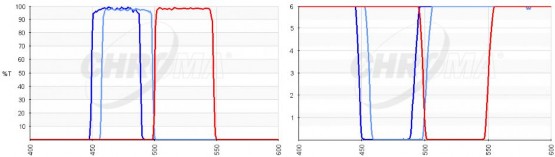
Usually, when we look at the parameters of a filter, we usually look at the transmittance spectrum, but the fluorescence intensity is often weak relative to the excitation light intensity. Therefore, when selecting a filter, we need to refer to the blocking depth spectrum diagram; — OD value. The OD value can more intuitively reflect the light blocking characteristics of the filter.
When selecting excitation filters and emission filters, the intersection point of their blocking depth spectra (OD intersection point) is an important criterion for judgment. Generally, it is required that the OD value of the intersection point be greater than 5 for wide field light source excitation and greater than OD6 for laser excitation, in order to achieve a good fluorescence signal-to-noise ratio.
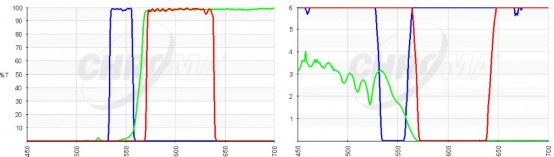
Sometimes the combination of transmission spectra of excitation and emission filters (EX and EM filters) looks perfect, but when converted into
After obtaining the OD value, it was found that the spectral intersection point was only OD1, which does not meet the basic requirements of fluorescence imaging. Therefore, it is generally recommended to have a certain distance between the transmission spectra of the excitation and emission filters, such as 10nm.
Naming rules for filters
Understanding the sensitive specifications of filters can enable users to quickly understand the products of various filter manufacturers, such as Olympus and Leica,
Nikon, Zeiss, Sunny, and Motic.
Excitation filter (ET480/40x)‐ ET represents the series of filters, with 480 as the center wavelength, 40 as the bandwidth (-/+20), and x representing the excitation plate.
Dichroic mirror (T495lpxr)‐ T represents the series of dichroic mirrors, and 495 represents the wavelength corresponding to 50% cut on.
Emission filter (ET535/50m)‐ ET represents the series of filters, with 535 as the center wavelength and 50 as the bandwidth (-/+25),
M represents the emitter.
T— Magnetron sputtering coated dichroic mirror, non laser application, typically at a 45 degree angle of incidence.
ET— Magnetron sputtering coating excitation or emission film, usually with 0-degree incidence angle.
ZT— Magnetron sputtering coated dichroic mirror, laser application, typically at a 45 degree angle of incidence. ZET— Magnetron sputtering coating excitation plate, laser application, usually 0-degree angle incidence.
lp/sp/bp— Long pass/short pass/band-pass.
NF— Short for notch filter.
DC— Dichroic abbreviation.
pc— Polychroic abbreviation, representing a multi band dichroic mirror. xr/xt— Abbreviation for extended reflection/extended transmission. xru— Extended reflection includes UV abbreviation.
TRF— Represents TIRF.
RET— Raman specific excitation or emission film.
RT— Raman specific dichroic mirror.
Precautions for customizing filters:
When the standard filter does not meet the usage requirements, customized filters/filters are needed. Ruicheng Optoelectronics provides various customized filter services for you.
Firstly, it is necessary to consider two quantities: the incident angle AOI and the cone angle Cone Angle. The incident angle is the angle at which the light is incident, for example, a dichroic mirror is generally 45 degrees Celsius; The cone angle is the angle between the edge ray and the center ray due to focusing or diverging, sometimes also expressed as a half cone angle.
The changes in incident angle and cone angle have a significant impact on the spectral curve of the filter. Increasing the incident angle may cause a blue shift in the filter curve, while the cone angle may reduce the transmission area of the dichroic mirror.
Secondly, the polarization of light needs to be considered. According to the Fresnel polarization formula, when light propagates at the interface between two substances, the reflectivity and transmittance are related to the polarization state of the light. Therefore, users must specify the polarization of the light when customizing to ensure that the final filter meets the requirements.
Fluorescent filter light source
LM-75 Metal Halide Lamp‐ — Imitation mercury lamp spectrum.
The service life reaches 1500 hours; Having standard mercury lamp spectral peaks;
Provide spectra in the 340-800nm wavelength range; Stable output;
Simple operation and high cost-effectiveness;
Can directly match with mainstream microscope interfaces in the current market without calibration.
Solar simulation filter:
Our company exclusively produces AM1.5 solar simulation filters, with a product grade of AAA+. The technology is unique and the effect is very good. AM stands for air mass, which means atmospheric quality. Because the zenith angle at which the sun is incident on the Earth varies in different dimensions, the zenith angle is the angle between the incident light and the ground normal, that is, the optical path length is different. Therefore, the relative equivalent atmospheric mass is also different. Using the formula AM& amp; 1/cos (z), where z is the zenith angle, it can be inferred that AM1.5 is effective for zenith angles of 48.2 degrees Celsius; Most countries, including China, Europe, and the United States, are located in this mid latitude region. Therefore, the solar spectrum on the surface is generally represented by AM1.5, with an energy of 1000W/m2.