Longpass Filter
Overview of Long Wave Pass Filter:
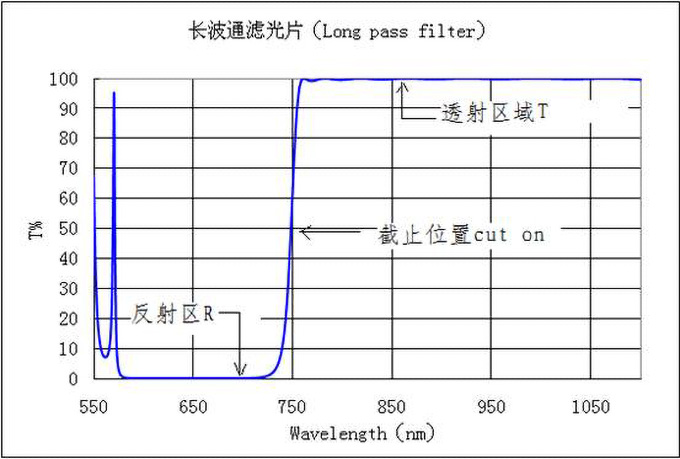
Long wave pass filter refers to an optical element that allows a certain range of long wave light to pass through or be highly transparent within a specific wavelength range, while blocking the short wave band below the cutoff point. Its function is to isolate a certain spectral band, and it is a type of cut-off filter. Ruicheng Optoelectronics stipulates that the position point of the long wave pass filter is identified by the wavelength point with a transmittance of 50%, and the LPF code is used to represent the long wave pass filter. Long wave pass filters, as an important optical component, have been widely used in fields such as biomedical beauty, digital imaging, machine vision, fingerprint recognition, etc. For example, infrared long wave pass filters can perform sharp light cutting at specific wavelengths. These filters are usually used for sequential classification, which can isolate a wide range of spectra and simultaneously transmit a large amount of required energy while cutting off excess energy. These filters are made of hard and durable dielectric coated optical infrared transmission substrates, which are resistant to cleaning and suitable for any high-quality optical component. They are particularly suitable for infrared spectroscopy and thermal imaging applications.
Classification of Long Wave Pass Filters:
It is mainly divided into reflective long wave pass filters and absorptive long wave pass filters. Reflective long wave pass filters are mainly produced using the principle of thin film interference and optical coating technology. They use durable dielectric films and can be cleaned and processed using general high-quality optical components. The basic structure of the thin film is a modified quarter wave thin film stack, which uses interference effects instead of absorption to isolate spectral bands; Absorption type long wave pass filters are mainly made of colored glass, which has the disadvantage of unstable optical curves. Ruicheng Optoelectronics can use optical coating on the substrate of colored glass to produce long wave pass filters with more precise optical indicators.
Spectral effect:
Unlike colored filter glass, as the incident angle increases, the starting and cutoff wavelengths of a long wave pass filter will shift towards shorter wavelengths. Generally speaking, when the incident angle changes from 0 degrees to 45 degrees, the center wavelength decreases by about 10%. In addition, our long wave pass filter is sealed to provide optimal humidity protection. Different filters can be combined to form custom bandpass filters.
Key points for selecting long wave pass filters:
1. Ideal choice for isolating wide spectral regions
2. Adopting durable outer surface coating
Ruicheng Optoelectronics provides high-quality long wave filters with high cutoff steepness between the passband and cutoff region. In the range of X-rays to 1200nm, the cutoff value is very high, and the average transmittance of the passband area exceeds 93%. Products with arbitrary optical parameters can be customized according to customer needs.
Long wave pass filter refers to an optical element that allows a certain range of long wave light to pass through or be highly transparent within a specific wavelength range, while blocking the short wave band below the cutoff point. Its function is to isolate a certain spectral band, and it is a type of cut-off filter. Ruicheng Optoelectronics stipulates that the position point of the long wave pass filter is identified by the wavelength point with a transmittance of 50%, and the LPF code is used to represent the long wave pass filter. Long wave pass filters, as an important optical component, have been widely used in fields such as biomedical beauty, digital imaging, machine vision, fingerprint recognition, etc. For example, infrared long wave pass filters can perform sharp light cutting at specific wavelengths. These filters are usually used for sequential classification, which can isolate a wide range of spectra and simultaneously transmit a large amount of required energy while cutting off excess energy. These filters are made of hard and durable dielectric coated optical infrared transmission substrates, which are resistant to cleaning and suitable for any high-quality optical component. They are particularly suitable for infrared spectroscopy and thermal imaging applications.
Classification of Long Wave Pass Filters:
It is mainly divided into reflective long wave pass filters and absorptive long wave pass filters. Reflective long wave pass filters are mainly produced using the principle of thin film interference and optical coating technology. They use durable dielectric films and can be cleaned and processed using general high-quality optical components. The basic structure of the thin film is a modified quarter wave thin film stack, which uses interference effects instead of absorption to isolate spectral bands; Absorption type long wave pass filters are mainly made of colored glass, which has the disadvantage of unstable optical curves. Ruicheng Optoelectronics can use optical coating on the substrate of colored glass to produce long wave pass filters with more precise optical indicators.
Spectral effect:
Unlike colored filter glass, as the incident angle increases, the starting and cutoff wavelengths of a long wave pass filter will shift towards shorter wavelengths. Generally speaking, when the incident angle changes from 0 degrees to 45 degrees, the center wavelength decreases by about 10%. In addition, our long wave pass filter is sealed to provide optimal humidity protection. Different filters can be combined to form custom bandpass filters.
Key points for selecting long wave pass filters:
1. Ideal choice for isolating wide spectral regions
2. Adopting durable outer surface coating
Ruicheng Optoelectronics provides high-quality long wave filters with high cutoff steepness between the passband and cutoff region. In the range of X-rays to 1200nm, the cutoff value is very high, and the average transmittance of the passband area exceeds 93%. Products with arbitrary optical parameters can be customized according to customer needs.