Application of Focusing Mirror in Fiber Laser Equipment
Focusing mirror is an optical component that can compress diverging laser beams in terms of angular direction. Due to the large emission surface of optical fibers, they are a diffuse beam of light rather than a collimated or focused spot. Fiber laser focusing mirror can effectively converge the beam at the end of the fiber and control the output beam in a very small area. According to the requirements of different applications, two or more focusing lenses can be used, and this optical component is called a composite focusing lens. Sometimes, non spherical focusing lenses are also used. From the perspective of usage effect, non spherical focusing lenses have the best effect, followed by composite focusing lenses.
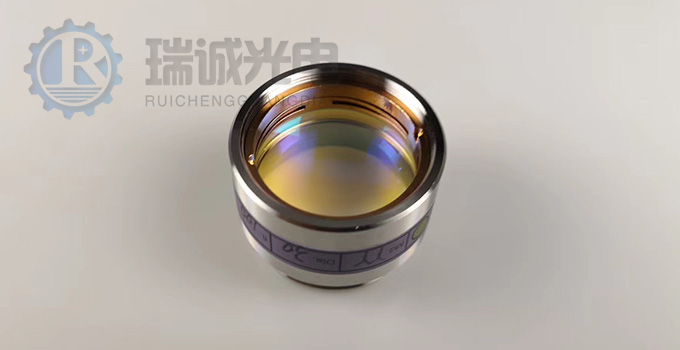
There are two structures for fiber focusing lenses, namely C and T interfaces, or directly connected to optical waveguides. The C interface and T interface require a standard optical fiber adapter that can be used with various optical fibers. In addition, other accessory C interface and T interface devices need to be added.
Focusing mirror is one of the core accessories of laser equipment such as fiber laser engraving machines, cutting machines, marking machines, welding machines, etc. The function is to form a uniform focal point on the entire standard plane, and its main performance indicators are: focal length and scanning range. The focal position depends on both the focal length and the deflection angle; The scanning range is proportional to the focal length of the scene. After focusing, the diameter of the light spot is proportional to the focal length, that is, the larger the diameter of the light spot obtained when the scanning area reaches a certain degree.
Focusing mirror for laser marking machine
In monochromatic light imaging, the image surface is a plane, and the image quality of the entire image surface is consistent, with minimal image differences. The deflection position of the incident beam is generally located at the focal point of the target space, with the main light parallel to the optical axis, which can greatly achieve consistency in off-axis image quality and improve illumination uniformity. Therefore, it has been widely used in laser marking systems.
Focusing lens is a professional lens system and one of the most important accessories of fiber laser marking machine. Without distortion, the position of the focal length depends on the tangent of the lens focal length and deflection angle, while the position of the focal length depends only on the focal length and deflection angle.
The function of a focusing mirror:
1. Improve the ability of detectors with edge light speed incidence;
2. In the same main optical system, additional field mirrors will reduce the area of the detector. If the same detector area is used, the field of view can be expanded and the incident flux can be increased;
3. The uniform illumination of the photosensitive surface of the detector can be homogenized.
Ruicheng Optoelectronics can provide users with focusing mirrors, composite focusing mirrors, and customized products of different sizes, curvature radii, and wavelengths for various laser equipment such as fiber laser marking machines, fiber laser engraving machines, fiber laser welding machines, and fiber laser cutting machines, such as focusing mirrors, high reflection mirrors, output mirrors, optical lenses, reflection mirrors, laser protection mirrors, vibrating lenses, etc.
There are two structures for fiber focusing lenses, namely C and T interfaces, or directly connected to optical waveguides. The C interface and T interface require a standard optical fiber adapter that can be used with various optical fibers. In addition, other accessory C interface and T interface devices need to be added.
Focusing mirror is one of the core accessories of laser equipment such as fiber laser engraving machines, cutting machines, marking machines, welding machines, etc. The function is to form a uniform focal point on the entire standard plane, and its main performance indicators are: focal length and scanning range. The focal position depends on both the focal length and the deflection angle; The scanning range is proportional to the focal length of the scene. After focusing, the diameter of the light spot is proportional to the focal length, that is, the larger the diameter of the light spot obtained when the scanning area reaches a certain degree.
Focusing mirror for laser marking machine
In monochromatic light imaging, the image surface is a plane, and the image quality of the entire image surface is consistent, with minimal image differences. The deflection position of the incident beam is generally located at the focal point of the target space, with the main light parallel to the optical axis, which can greatly achieve consistency in off-axis image quality and improve illumination uniformity. Therefore, it has been widely used in laser marking systems.
Focusing lens is a professional lens system and one of the most important accessories of fiber laser marking machine. Without distortion, the position of the focal length depends on the tangent of the lens focal length and deflection angle, while the position of the focal length depends only on the focal length and deflection angle.
The function of a focusing mirror:
1. Improve the ability of detectors with edge light speed incidence;
2. In the same main optical system, additional field mirrors will reduce the area of the detector. If the same detector area is used, the field of view can be expanded and the incident flux can be increased;
3. The uniform illumination of the photosensitive surface of the detector can be homogenized.
Ruicheng Optoelectronics can provide users with focusing mirrors, composite focusing mirrors, and customized products of different sizes, curvature radii, and wavelengths for various laser equipment such as fiber laser marking machines, fiber laser engraving machines, fiber laser welding machines, and fiber laser cutting machines, such as focusing mirrors, high reflection mirrors, output mirrors, optical lenses, reflection mirrors, laser protection mirrors, vibrating lenses, etc.