The difference between circularly polarized light and linearly polarized light
Polarized light is a type of light wave with specific vibration direction, which can vibrate in a specific plane or rotate in a specific way. According to the different polarization states, light waves can be divided into linearly polarized light, circularly polarized light, and elliptically polarized light. This article will focus on introducing the basic concepts, generation methods, and main differences between linearly polarized light and circularly polarized light.
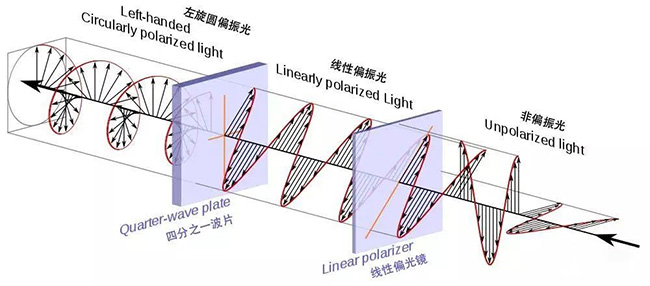
linearly polarized light
Linear polarized light, also known as plane polarized light, refers to the vibration direction of light waves always being in a fixed plane and not rotating. The characteristic of linearly polarized light is that it has two perpendicular vibration components, one in a plane perpendicular to the propagation direction and the other along the propagation direction. Linear polarized light can be generated through certain physical processes, such as polarizing plates made of glass or plastic, or through interference and diffraction of light.
The application of linearly polarized light is very extensive, such as in optical instruments, laser technology, liquid crystal displays, and polarized sunglasses. A significant feature of linearly polarized light is that it can be blocked by polarizing plates, so polarizing plates are commonly used to reduce glare and improve visual clarity.
circularly polarized light
Circularly polarized light is a special polarization state characterized by the vibration direction of light waves rotating at a fixed angular velocity during propagation. Circularly polarized light can be decomposed into two linearly polarized components, whose vibration directions are perpendicular to each other and their phase difference is constant, causing the vibration direction of the light wave to rotate in a circular form in the observer's field of view.
The generation of circularly polarized light usually depends on nonlinear optical processes or certain special crystal structures. For example, circularly polarized light can be generated through Faraday rotation effect or optical interference. Circularly polarized light is of great significance in scientific research and technological applications, with applications in optical measurement, quantum information processing, biomedical imaging, and other fields.
Main differences
Change in vibration direction
The vibration direction of linearly polarized light remains unchanged during propagation, while the vibration direction of circularly polarized light rotates in a circular form.
Generation method
Linear polarized light can be easily generated through polarizing plates, interference, diffraction, and other methods. The generation of circularly polarized light typically requires nonlinear optical processes or special crystal structures, which are more complex.
The effect of polarizing film
Linear polarized light can be blocked by polarizing plates because they only allow vibrations in specific directions to pass through. Circular polarized light cannot be blocked by a regular polarizer because it contains two perpendicular vibration components that can pass through the polarizer simultaneously.
Application Areas
The application of linearly polarized light is very extensive, such as in polarized sunglasses, liquid crystal displays, and other fields. Circularly polarized light has unique applications in fields such as optical measurement, quantum information processing, and biomedical imaging.
Conclusion
Linear polarized light and circularly polarized light are two different polarization states, which have significant differences in terms of changes in vibration direction, generation methods, polarizer effects, and application fields. Understanding these differences is of great significance for both scientific research and engineering technology, as it can help us better understand and utilize the applications of polarized light in different fields.