Near infrared interference narrowband filter
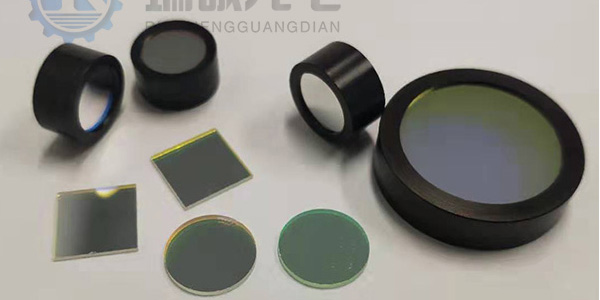
Near infrared interference narrowband filter is a type of infrared filter widely used in various fields such as biometric recognition. Interference filters or narrowband filters play an indispensable role in suppressing background noise in photodetectors. Thin film researchers have done a lot of work in the design and manufacturing of filters. Some thin film materials available for researchers in the near-infrared region, such as ZnS-mgf2, These material combinations are relatively soft or unstable, and their peak wavelengths are affected by humidity. In order to solve these problems, some people propose using ion assisted methods to plate filters with low temperature drift phenomenon. Another method is to glue and seal the thin film in glass. This type of filter is usually called a glued filter in the industry. Two to three filters with different optical parameters are glued together, and the film is glued in the middle to achieve the desired optical indicators.
We use Si and SiO2 as coating materials for the wavelength range of 1000nm-3000nm. This is because these materials do not absorb in the 1000nm-3000nm wavelength range and have stable performance. Another advantage is that Si has a high refractive index in the infrared region, so it only needs to be coated with fewer film layers and thinner film thickness to meet design requirements.
The design requirements for the optical latent characteristics of the interference filter are: cutoff before 1050nm-1320nmHT, 1450-2750nm, and 800nm. The base material is K9 glass, with one side coated with a filter and the other side coated with an anti reflective film (for the transmission band). These two types of membranes should have a certain degree of stability, be able to be exposed to air, and pass environmental tests.
We use Si and SiO2 as high and low refractive index materials. Due to the requirement of a wide cutoff band in the 1450-2750nm wavelength range for the filter, we use two short wave pass filter film systems with different center wavelengths to meet the design requirements. The filter also requires a cutoff before 1050nm. Due to the absorption of Si before 1000nm and the high order reflection band of the second short wave pass filter, there is no need to use a color filter to suppress the short wave background.
The difficulty of designing this film system lies in connecting two short wave pass film systems, which requires meeting the cutoff band width, avoiding the generation of transmission sub peaks at the connection between the two film systems, and avoiding the influence of the reflection band half wave hole on the transmission band transmittance.
The difficulty of designing this film system lies in connecting two short wave pass film systems, which requires meeting the cutoff band width, avoiding the generation of transmission sub peaks at the connection between the two film systems, and avoiding the influence of the reflection band half wave hole on the transmission band transmittance.