optical glass
Optical materials are the objects of various optical component processing and are an important component of optical instruments. Optical materials include optical plastics, optical glass, and optical crystals.
Composition of optical glass
The main differences between optical glass and ordinary glass are as follows: optical glass contains most of the elements in the periodic table, but with different compositions and contents. Optical glass has physical and chemical uniformity, high transparency, and specific and precise optical constants.
Usually, silica, also known as quartz sand, is the main component of optical glass. When melting glass, other substances should be added to improve the performance of the glass and meet the needs of relational imaging. For example, adding alumina can improve the chemical stability and mechanical strength of glass; Adding lead oxide and barium oxide can increase the refractive index of glass, but the chemical stability decreases; Adding sodium oxide can lower the melting temperature of glass; In addition, other oxides can enhance the chemical stability and mechanical strength of glass. Glass mainly composed of silicon dioxide belongs to silicate glass, while the main component of boron trioxide B2O3 belongs to borosilicate glass, and the main component of phosphorus pentoxide P2O5 belongs to phosphate glass.
Physical properties of optical glass
Glass material form: Strictly speaking, glass is not a solid. There is no definite solidification temperature during the cooling process of glass melt. Glass retains the irregular arrangement of liquid molecules, which means that low-temperature solids retain the high-temperature liquid structure, known as the glassy state.
Physical properties of glass
Isotropic: The hardness, elastic modulus, refractive index, and other properties of glass are the same in all directions.
Classification and naming of optical glass
There are many types of optical glass, most of which are colorless optical glass. The name of optical glass mainly refers to colorless optical glass.
Optical glass varieties and grades: Each country and glass manufacturer has its own variety classification and brand representation method, mostly using Latin letters as variety symbols, such as K, ZF, F, etc., followed by trademarks.
According to the classification methods of various countries, optical glass can be divided into two categories based on the Abbe coefficient, namely crown glass and flint glass, with a rough boundary ofγ =50; In China, K represents crown glass and F represents flint glass.
Under the two types of glass, namely crown plate and flint, other smaller categories are also derived based on their refractive index and chemical composition.
Colorless optical glass classification
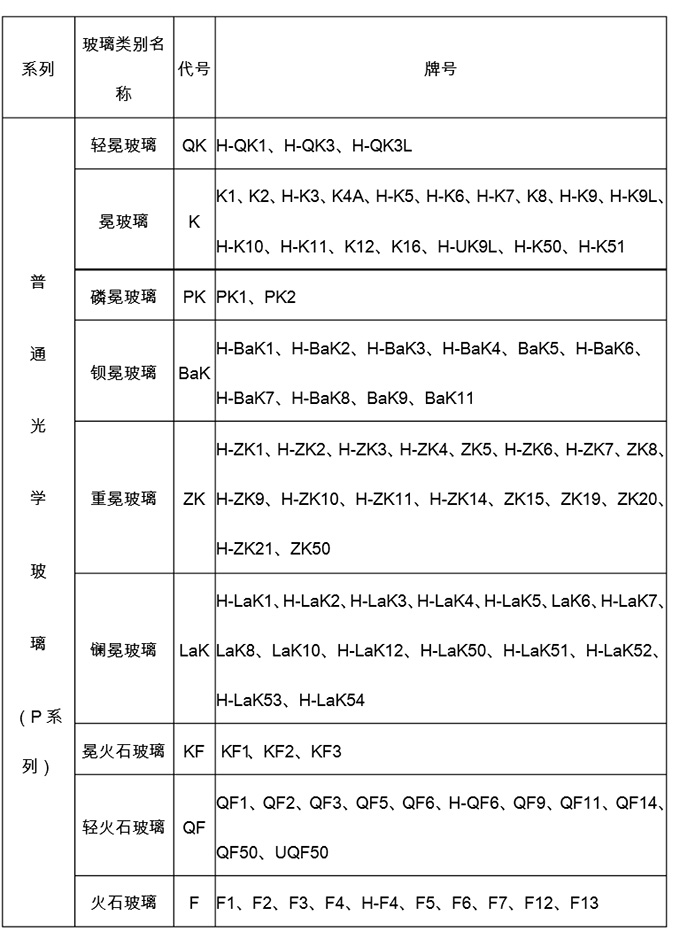
According to the position of dispersion coefficient vd and refractive index nd, as well as the composition of the glass, colorless optical glass is divided into 16 categories: see the attached grade table
Optical glass grade
Each optical glass grade consists of the code name and serial number of the glass class to which it belongs. In addition, each brand is represented by six values, with the first three values representing the third decimal place of the refractive index of the brand glass, and the last three values representing the Abbe number of the brand glass.
Lead free, arsenic free, cadmium free glass grades:
Glass labels containing lead-free, arsenic, cadmium, and other radioactive elements all have the words'; H” And“ -” The prefix, such as H-K9L.
Attachment - List of Optical Glass Grades:
Composition of optical glass
The main differences between optical glass and ordinary glass are as follows: optical glass contains most of the elements in the periodic table, but with different compositions and contents. Optical glass has physical and chemical uniformity, high transparency, and specific and precise optical constants.
Usually, silica, also known as quartz sand, is the main component of optical glass. When melting glass, other substances should be added to improve the performance of the glass and meet the needs of relational imaging. For example, adding alumina can improve the chemical stability and mechanical strength of glass; Adding lead oxide and barium oxide can increase the refractive index of glass, but the chemical stability decreases; Adding sodium oxide can lower the melting temperature of glass; In addition, other oxides can enhance the chemical stability and mechanical strength of glass. Glass mainly composed of silicon dioxide belongs to silicate glass, while the main component of boron trioxide B2O3 belongs to borosilicate glass, and the main component of phosphorus pentoxide P2O5 belongs to phosphate glass.
Physical properties of optical glass
Glass material form: Strictly speaking, glass is not a solid. There is no definite solidification temperature during the cooling process of glass melt. Glass retains the irregular arrangement of liquid molecules, which means that low-temperature solids retain the high-temperature liquid structure, known as the glassy state.
Physical properties of glass
Isotropic: The hardness, elastic modulus, refractive index, and other properties of glass are the same in all directions.
Classification and naming of optical glass
There are many types of optical glass, most of which are colorless optical glass. The name of optical glass mainly refers to colorless optical glass.
Optical glass varieties and grades: Each country and glass manufacturer has its own variety classification and brand representation method, mostly using Latin letters as variety symbols, such as K, ZF, F, etc., followed by trademarks.
According to the classification methods of various countries, optical glass can be divided into two categories based on the Abbe coefficient, namely crown glass and flint glass, with a rough boundary ofγ =50; In China, K represents crown glass and F represents flint glass.
Under the two types of glass, namely crown plate and flint, other smaller categories are also derived based on their refractive index and chemical composition.
Colorless optical glass classification
According to the position of dispersion coefficient vd and refractive index nd, as well as the composition of the glass, colorless optical glass is divided into 16 categories: see the attached grade table
Optical glass grade
Each optical glass grade consists of the code name and serial number of the glass class to which it belongs. In addition, each brand is represented by six values, with the first three values representing the third decimal place of the refractive index of the brand glass, and the last three values representing the Abbe number of the brand glass.
Lead free, arsenic free, cadmium free glass grades:
Glass labels containing lead-free, arsenic, cadmium, and other radioactive elements all have the words'; H” And“ -” The prefix, such as H-K9L.
Attachment - List of Optical Glass Grades: