Detailed explanation of optical lenses
The concept of lens:
A lens is an optical component made of transparent materials based on the principle of light refraction, with a non planar surface. With the development of advanced equipment manufacturing industry in China, lenses are widely used in various fields such as laser equipment, optical instruments, security equipment, vehicle mounted equipment, digital instruments, etc., and the demand is increasing.
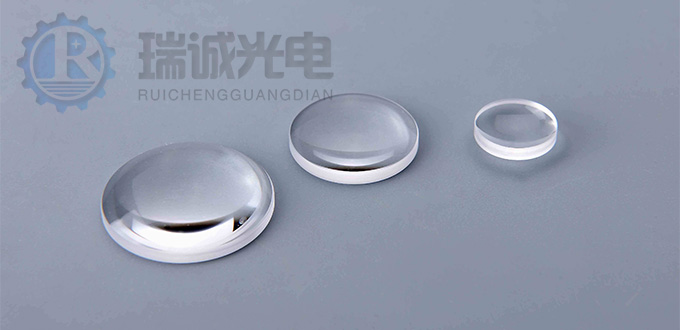
Classification of lenses:
It can be divided into convex lenses and concave lenses, with thick edge lenses called concave lenses and lenses with thick middle edges called convex lenses. Convex lenses converge light, while concave lenses diverge light. If we divide it into various lenses such as plano convex lenses, biconcave lenses, crescent lenses, objective lenses, eyepieces, etc., which we often see in our daily lives, there are multiple lenses combined together to achieve corresponding optical functions, such as the focusing lens in laser equipment. The collimating lens is a copper lens that combines two to three lenses to achieve collimation and focusing functions.
Physical characteristics of lenses:
Here we need to understand the following concepts: optical center and main optical axis. The main optical axis refers to the straight line passing through the center of the lens; And each lens has a point on its main axis, through which the direction of light propagation does not change, which is called the optical center.
Light is refracted through a convex lens, and the direction of propagation of refracted light is closer to the main optical axis than the direction of propagation of incident light; After being refracted by a concave convex mirror, the refracted light propagates further away from the main optical axis than the original incident light.
Focus and focal length: A convex lens can converge light parallel to the main optical axis at a point on the main optical axis, which is called the focal point. The distance from the focal point to the optical center is called the focal length; A concave convex mirror causes light parallel to the main optical axis to diverge, and the reverse extension line of the diverging light will converge at a point on the main optical axis, which is the focal point of the concave convex mirror. Similarly, the distance from the focal point to the optical center is the focal length of the concave convex mirror. The size of the focal length of a convex lens indicates the strength of its convergence ability. The smaller the focal length, the stronger the convergence ability; The size of the focal length of a concave lens indicates the strength of its divergence ability, with smaller focal lengths indicating stronger divergence ability. The convexity of the surface of a convex lens determines the length of the focal length. The more protrusions there are, the shorter the focal length, and the stronger the focusing ability. The degree of concavity on the surface of a concave lens determines its focal length. The more concavities there are, the shorter the focal length, and the stronger the scattering ability. The focal length of each convex lens and concave lens is fixed. However, the focal length of colored light varies among different colors of the same lens. A plano convex lens can converge a collimated beam onto the back focal point, or turn a point light source into a collimated beam.
Methods for distinguishing convex and concave lenses:
1. Detecting lenses, thin edges and thick middle are convex lenses, thin middle and thick edges are concave lenses;
2. Using parallel light detection, convex lenses are converging lenses, while concave lenses have a diverging effect on light .
3. Convex lenses can be displayed on a light curtain, while concave lenses cannot be displayed on a light curtain.
The lenses produced by Ruicheng Optoelectronics generally use K9 or quartz optical glass, and their anti reflective coating is designed for the wavelength range of 400-700nm. In addition, ultraviolet quartz can be used as the substrate for making lenses, which have good transmittance and low thermal expansion coefficient in the ultraviolet region.
A lens is an optical component made of transparent materials based on the principle of light refraction, with a non planar surface. With the development of advanced equipment manufacturing industry in China, lenses are widely used in various fields such as laser equipment, optical instruments, security equipment, vehicle mounted equipment, digital instruments, etc., and the demand is increasing.
Classification of lenses:
It can be divided into convex lenses and concave lenses, with thick edge lenses called concave lenses and lenses with thick middle edges called convex lenses. Convex lenses converge light, while concave lenses diverge light. If we divide it into various lenses such as plano convex lenses, biconcave lenses, crescent lenses, objective lenses, eyepieces, etc., which we often see in our daily lives, there are multiple lenses combined together to achieve corresponding optical functions, such as the focusing lens in laser equipment. The collimating lens is a copper lens that combines two to three lenses to achieve collimation and focusing functions.
Physical characteristics of lenses:
Here we need to understand the following concepts: optical center and main optical axis. The main optical axis refers to the straight line passing through the center of the lens; And each lens has a point on its main axis, through which the direction of light propagation does not change, which is called the optical center.
Light is refracted through a convex lens, and the direction of propagation of refracted light is closer to the main optical axis than the direction of propagation of incident light; After being refracted by a concave convex mirror, the refracted light propagates further away from the main optical axis than the original incident light.
Focus and focal length: A convex lens can converge light parallel to the main optical axis at a point on the main optical axis, which is called the focal point. The distance from the focal point to the optical center is called the focal length; A concave convex mirror causes light parallel to the main optical axis to diverge, and the reverse extension line of the diverging light will converge at a point on the main optical axis, which is the focal point of the concave convex mirror. Similarly, the distance from the focal point to the optical center is the focal length of the concave convex mirror. The size of the focal length of a convex lens indicates the strength of its convergence ability. The smaller the focal length, the stronger the convergence ability; The size of the focal length of a concave lens indicates the strength of its divergence ability, with smaller focal lengths indicating stronger divergence ability. The convexity of the surface of a convex lens determines the length of the focal length. The more protrusions there are, the shorter the focal length, and the stronger the focusing ability. The degree of concavity on the surface of a concave lens determines its focal length. The more concavities there are, the shorter the focal length, and the stronger the scattering ability. The focal length of each convex lens and concave lens is fixed. However, the focal length of colored light varies among different colors of the same lens. A plano convex lens can converge a collimated beam onto the back focal point, or turn a point light source into a collimated beam.
Methods for distinguishing convex and concave lenses:
1. Detecting lenses, thin edges and thick middle are convex lenses, thin middle and thick edges are concave lenses;
2. Using parallel light detection, convex lenses are converging lenses, while concave lenses have a diverging effect on light .
3. Convex lenses can be displayed on a light curtain, while concave lenses cannot be displayed on a light curtain.
The lenses produced by Ruicheng Optoelectronics generally use K9 or quartz optical glass, and their anti reflective coating is designed for the wavelength range of 400-700nm. In addition, ultraviolet quartz can be used as the substrate for making lenses, which have good transmittance and low thermal expansion coefficient in the ultraviolet region.