Blue glass filter
Apple has introduced the iPhone 4/4S since then; Blue Glass Filter; This greatly improves the quality of photography. Afterwards, whether it was Xiaomi 2 or Meizu MX2, high-end phones equipped with 8 million or more pixels began to popular back illuminated cameras with embedded blue glass filters. So, what is the purpose of this small blue glass and how effective is it during filming?
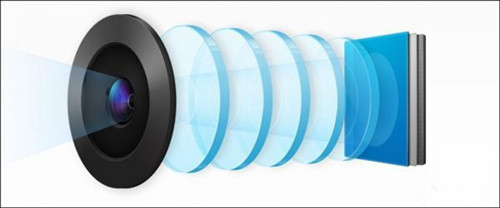
Infrared light affects imaging quality
Firstly, we need to understand some small knowledge: any object emits infrared radiation in an environment above absolute zero (-273 ℃); Mobile phone cameras use CCD or CMOS sensors; CCD and CMOS sensors can sensitively capture all visible light regions and some infrared light regions.
According to the principle and law of refraction of light, it can be concluded that the longer the wavelength, the smaller the refractive index; The shorter the wavelength, the higher the refractive index. Therefore, when these light rays enter the mobile phone camera at the same time and are refracted by the lens, visible light and infrared light will form images on different target surfaces. The imaging of visible light is a color image, while the imaging of infrared light is a black and white image. When we adjust the image formed by visible light, which is called image focusing and back focus adjustment, infrared light will form a virtual image on this target surface, thereby affecting the color and quality of the image.
The efficacy of blue glass filter
The most effective way to avoid virtual images on the target surface caused by infrared light is to filter out infrared light through IR coating or installing filters, restore the true color of the object, and thus solve the problem of image color distortion.
The difference between blue glass and other filters is that the raw materials are different. Blue glass is made of blue glass material as the raw material (ordinary optical filters are made of ordinary optical glass), and its effectiveness depends on; Absorption” Filter infrared light in a certain way. Due to the higher transmittance of blue wavelength, it has better penetration than red orange glass filters and can filter infrared light above 630nm (but allows a wide range of light from ultraviolet to infrared to pass through), and the filtering is more thorough. It should be noted that although blue glass filters filter infrared light, there is currently no filter that can make object imaging brighter because all filters absorb certain wavelengths and make objects darker.
Tip: Disadvantages of Coating
IRCoating coating is divided into two types: vacuum coating and chemical coating, which can filter out infrared light with wavelengths above 650nm. But compared to blue glass; Absorption” Filtering is different, IRCoating coating relies on; Reflection” The method filters out infrared light, while reflected light can easily cause interference. In addition, IRCoating coating needs to be customized for different models and specifications of CMOS to achieve the best results, which is not as effective or versatile as blue glass.
For this reason, blue glass filters often require a coating called ARCoating (different from the IRCoating coating mentioned earlier) to increase transmittance and reflect infrared light. We all know that light undergoes refraction and reflection when passing through different media. When single-sided AR coating is added, the transmittance of the filter can be increased by 3-5%. If double-layer or even four layer AR coating is added, the transmittance of the filter can reach over 98%, making the image clearer and reducing the risk of fogging. On the contrary, if ARCoating coating is not added, the transmittance of the filter will be lower than 90%, which will significantly reduce the camera's sensitivity and affect the imaging quality (the image will be very dim).