Incident angle of filter
1、 Narrowband filters in optical thin films have a wide range of applications in optical communication systems. They have the advantages of narrow passband, low insertion loss, and good temperature stability. Narrowband filters are commonly used for orthogonal incidence and are typically directly solidified for collimators. However, with the development of science and technology, narrowband filters with oblique incidence are often needed. When the light is obliquely incident, the polarization dependent loss of the narrowband filter increases, and the peak and bandwidth of the narrowband filter will shift towards the short wave direction, resulting in a wider intensity distribution and beam broadening, which seriously affects performance. Optical communication system. This article analyzes the reasons for polarization separation and its relationship with the equivalent refractive index of filters, and theoretically analyzes the transmission intensity distribution characteristics of narrowband filters under oblique incidence of Gaussian beams.
2、 Structure and principle of narrowband filter
Narrowband filter is a multi-layer film system based on the principle of multi beam interference, which filters out narrowband near monochromatic white light. Its basic structure consists of reflective layers and spacer layers alternately stacked with high and low refractive index thin films. For high refractive index and low refractive index thin films, the optical thickness of each layer is an integer multiple of 1/4 of the center wavelength. Due to odd or even phase shifts, the reflected light from the low refractive index layer passes through the phase shift and superimposes the reflected light from the high refractive index layer in the direction or opposite direction, reflecting the result of PHA. The consumption of selenium length and light intensity. In this way, near the center wavelength, each layer of reflected light is superimposed to eliminate each other, and a strong transmitted light is formed at the front of the filter.
3、 The influence of oblique light entering a narrowband filter on the wavelength of light
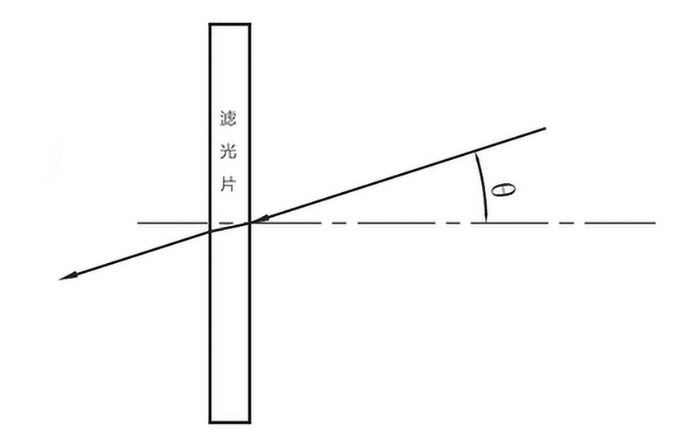
In some systems, obliquely incident light must enter through a filter. When the incident angle increases to a certain angle, the optical characteristics of the filter begin to change. Firstly, the passband position, i.e. the peak wavelength, will shift to the opposite short wave; Secondly, the characteristics of polarized light will be separated, resulting in changes in peak and bandwidth.
Many people mistakenly believe that the incident angle is the angle between the position of the light source and the center and normal direction of the filter. If the collimated light path does not pass through, even if the light source is installed on the center normal of the filter, the light will still diverge, that is, the incident angle is not 0 °;.
If there is a certain range of angle between the incident light and the normal direction of the filter, a specific angle range should be specified because the design of interference filters is very sensitive to angles. For narrowband filters designed below 0 degrees, the effect will be completely different if used at different angles. The following figure is an example study of an 850 nanometer narrowband filter. As the incident angle increases, the position of the center wavelength shifts towards shorter wavelengths.
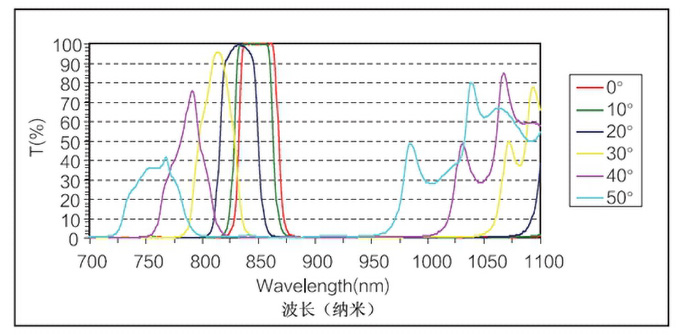
As long as an interference filter is used, angular effects cannot be avoided, which is the basic characteristic of interference filters. From the graph, it can be seen that when at 50 ° C; When using an 850 nm narrowband filter, it is no longer an 850 nm narrowband filter, but a narrowband filter of approximately 760 nm. This is also why users often need to place a filter between the CCD and the lens, because the divergence angle of the light in front of the CCD is not too large, usually less than 12 degrees. When placed in front of the lens, when facing an object, the filter receives a larger angle. There is no interference light within a large angle range.
2、 Structure and principle of narrowband filter
Narrowband filter is a multi-layer film system based on the principle of multi beam interference, which filters out narrowband near monochromatic white light. Its basic structure consists of reflective layers and spacer layers alternately stacked with high and low refractive index thin films. For high refractive index and low refractive index thin films, the optical thickness of each layer is an integer multiple of 1/4 of the center wavelength. Due to odd or even phase shifts, the reflected light from the low refractive index layer passes through the phase shift and superimposes the reflected light from the high refractive index layer in the direction or opposite direction, reflecting the result of PHA. The consumption of selenium length and light intensity. In this way, near the center wavelength, each layer of reflected light is superimposed to eliminate each other, and a strong transmitted light is formed at the front of the filter.
3、 The influence of oblique light entering a narrowband filter on the wavelength of light
In some systems, obliquely incident light must enter through a filter. When the incident angle increases to a certain angle, the optical characteristics of the filter begin to change. Firstly, the passband position, i.e. the peak wavelength, will shift to the opposite short wave; Secondly, the characteristics of polarized light will be separated, resulting in changes in peak and bandwidth.
Many people mistakenly believe that the incident angle is the angle between the position of the light source and the center and normal direction of the filter. If the collimated light path does not pass through, even if the light source is installed on the center normal of the filter, the light will still diverge, that is, the incident angle is not 0 °;.
If there is a certain range of angle between the incident light and the normal direction of the filter, a specific angle range should be specified because the design of interference filters is very sensitive to angles. For narrowband filters designed below 0 degrees, the effect will be completely different if used at different angles. The following figure is an example study of an 850 nanometer narrowband filter. As the incident angle increases, the position of the center wavelength shifts towards shorter wavelengths.
As long as an interference filter is used, angular effects cannot be avoided, which is the basic characteristic of interference filters. From the graph, it can be seen that when at 50 ° C; When using an 850 nm narrowband filter, it is no longer an 850 nm narrowband filter, but a narrowband filter of approximately 760 nm. This is also why users often need to place a filter between the CCD and the lens, because the divergence angle of the light in front of the CCD is not too large, usually less than 12 degrees. When placed in front of the lens, when facing an object, the filter receives a larger angle. There is no interference light within a large angle range.