Application of Flow Cytometer Filter
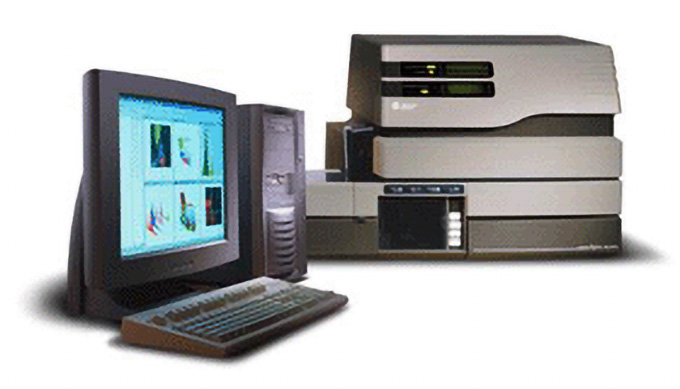
Flow cytometry (FCM) is a cell analyzer used to detect the fluorescence intensity of stained cell markers. It is a high-tech method for rapidly measuring and collecting physical or chemical properties of cells, such as size, internal structure, DNA, RNA, proteins, antigens, etc. Based on the analysis and classification of single cells.
Working principle introduction: Using laser as the excitation source to ensure better monochromaticity and excitation efficiency; The combination of fluorescent dyes and monoclonal antibody technology ensures the sensitivity and specificity of detection; Computer systems are used to achieve multi parameter signals of single cells in a flowing single-cell suspension. Data processing and analysis ensure detection speed and accuracy of statistical analysis.
Flow cytometry mainly consists of five parts:
1. Flow chamber and liquid flow drive system;
2. Laser light source and beam forming system;
3. Optical system;
4. Signal detection and storage, display and analysis system;
5. Cell sorting system.
Among them, the laser source and beam forming system: Flow cytometry can be equipped with one or more laser tubes. The commonly used laser tube is an argon ion gas laser tube. Its emission wavelength is 488nm. In addition, it can also be equipped with helium neon ion gas laser tubes (wavelength 633nm) and/or ultraviolet laser tubes.
The main signal fluorescence detected by flow cytometry is excited by excitation light. The intensity of fluorescence signal is related to the intensity of excitation light and irradiation time. Laser is a coherent light source that can provide a single wavelength, high-intensity, and highly stable light source, making it an ideal excitation light source to meet this requirement.
There are two cylindrical lenses between the laser source and the flow cavity. The circular cross-section laser beam emitted by the laser source is focused into an elliptical laser beam with a smaller cross-section (22 microns x 66 microns). In this elliptical laser spot, the laser energy is normally distributed, so the irradiation intensity of the cells in the laser detection area is a pair.
The optical system consists of several sets of lenses, holes, and filters, which can be divided into two groups: the front and back of the flow chamber. The main function of the lenses and small holes (usually two lenses and one small hole) is to focus the laser beam with a circular cross-section emitted by the laser source into an elliptical laser beam with a smaller cross-section, so that the laser energy can be distributed normally and the cells can obtain the detection area through the laser. The optical system behind the flow chamber is mainly composed of several sets of filters. The main function of a filter is to send fluorescence signals of different wavelengths to different photomultiplier tubes.
There are three main types of filters: long wave filters (LPF) - which only allow light to pass through a specific wavelength, short wave pass filters (SPF) - which only allow light below a specific wavelength, and bandpass filters (BPF) - which only allow light to pass through a specific wavelength. Different filter combinations can send fluorescence signals of different wavelengths to different photomultiplier tubes (PMT). For example, the filter configured in front of the PMT that receives green fluorescence (FITC) is the filter that receives orange red fluorescence (PE) configured in front of the PMT of LPF 550 and BPF 525, while the filters configured in front of the PMT that receives red fluorescence (CY5) of LPF 600 and BPF 575 are LPF 650 and BPF 675.
At the beginning of its invention, flow cytometry was mainly used for cell classification. With the development of computer technology, immunology, and the invention of monoclonal antibody technology, it has been increasingly widely used in biology, medicine, and pharmacy fields such as cell dynamics analysis, cell apoptosis, cell classification, and cancer diagnosis. There are many fields, such as drug discontinuation, drug efficacy analysis, etc. In recent years, the development of multifunctional flow cytometry, the establishment of multi parameter analysis techniques, and the development of various powerful analysis software have provided guarantees for improving the accuracy of flow cytometry detection results and expanding analysis capabilities.