IR cut filter and day night dual pass filter
The infrared cut filter, also known as the IR cut filter in English, is placed between the lens and the sensor. The human eye and CMOS sensor have different responses to light of various wavelengths. The human eye cannot see infrared light, but the sensor can sense near-infrared light, which can cause the sensor to perceive red light too strongly and form color cast. Therefore, an infrared cut-off filter is required to block near-infrared light. Mainly plating IR cut film on ultra-thin optical glass to enable it to be stacked and combined with lens products.
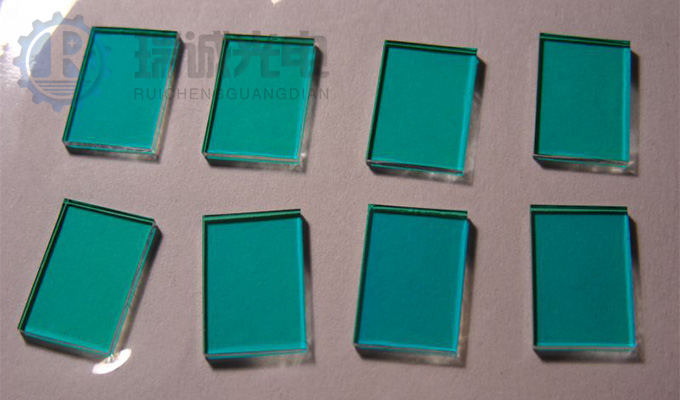
IR cut filters are divided into two types: reflective and absorptive. Reflective IR cut filters have higher transmittance and lower reflectivity in the visible light range, while the opposite is true in the infrared region, with higher reflectivity. Therefore, when the camera captures at a certain angle, infrared light will cause significant reflection on the film. When light is reflected multiple times by the lens group, it will form a halo on the photo.
The absorption type IR cut filter uses blue glass, which is itself an absorbing glass. Copper ions in the glass have an absorption effect on infrared radiation and do not have significant reflection. When the camera takes photos at an angle, the light mainly absorbs through the blue glass, and the infrared light reflected multiple times by the lens group is very weak, so it will not form a halo phenomenon in the photo.
IR cut filters are mainly used in CCD/CMOS digital imaging systems such as mobile phone cameras, digital cameras, digital camcorders, computer cameras, CCTV cameras, video phones, and video doorbells. They can effectively improve the impact of infrared radiation on CCD/CMOS imaging, prevent false colors and ripples generated by image sensors, and improve the effective resolution and color reproduction of color CCD and CMOS image sensors.
Dual pass filter for day and night use
Infrared light is a kind of stray light for color surveillance cameras under visible light conditions such as daytime, which can reduce the clarity and color recovery of color surveillance cameras. There are currently two methods to enable color surveillance cameras to sense infrared light under nighttime conditions. Firstly, turn on the filter and cover the infrared with visible light. In the absence of visible light, remove the filter and allow infrared radiation to enter. This solution achieves good image quality, but requires the use of a hardware called a switcher. Not only does it increase costs, but the failure rate of switches is also high. Secondly, a specific infrared channel is opened on the filter to allow infrared light with the same wavelength as the infrared lamp to enter. This is a day night dual channel filter, which is composed of an optical glass substrate and a filter film deposited on the optical glass substrate. It can block ultraviolet and infrared light in the mixed light source, helping digital cameras CCD or CMOS to no longer be affected by ultraviolet and infrared signals and obtain clearer images; At the same time, the filter can selectively pass through part of the infrared spectrum according to the different characteristics of the infrared lamp, enhancing the night vision function of the digital camera. The day and night dual-use filter can pass visible light of 420nm-620nm and 850nm infrared light, and block near-infrared light of 920nm-1100nm. It can obtain true color images during the day and clear black and white images at night. Mainly used for CCD chip color cameras and CMOS imaging systems, security monitor cameras, digital cameras, network cameras, video phones, doorbells, digital telescopes, license plate recognition cameras, etc., it has strong resistance to strong light and stray light interference and low color distortion.
The IR cut filter and day night dual pass filter produced by Ruicheng Optoelectronics are coated with imported optical glass, which has good transmittance in the visible light range and a high cutoff rate in the near-infrared band. The sunlight color is realistic, and the night vision infrared is transparent, which can filter strong light to make the color of the painting softer, achieving consistent visual color for human eyes. It is the best choice for various applications.