Machine vision filter
Enabling the transmission of light of allowed wavelengths and the cutoff of light of other wavelengths plays a role in suppressing optical noise and enhancing optical signals, thereby providing good preprocessing for image recognition, reducing recognition workload, improving recognition accuracy and efficiency, and enhancing recognition capability. Machine vision filters have a series of characteristics such as small size, good imaging quality, and long lifespan. They are an indispensable and important component of machine vision systems. 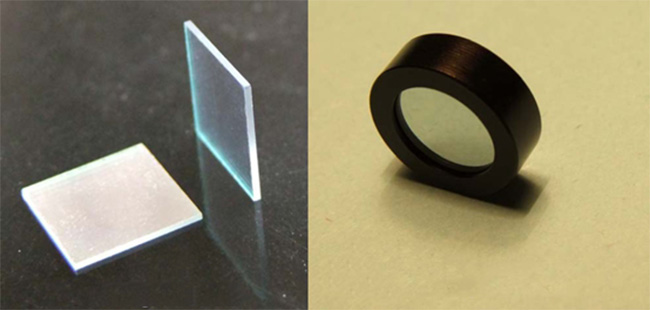
According to usage needs, some machine vision filters have loops, while others are bare chip.
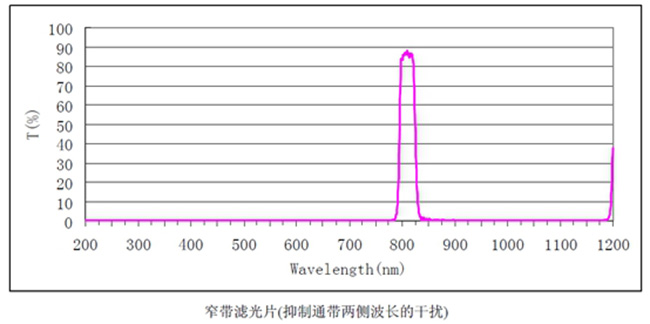
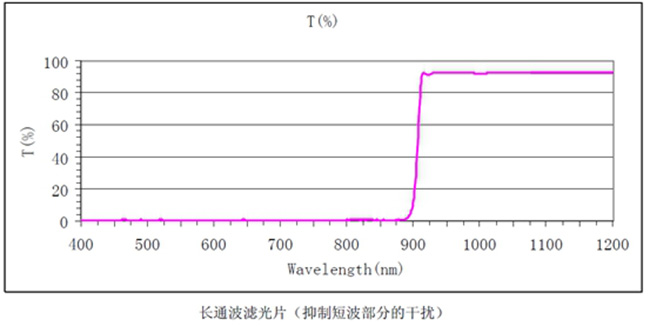
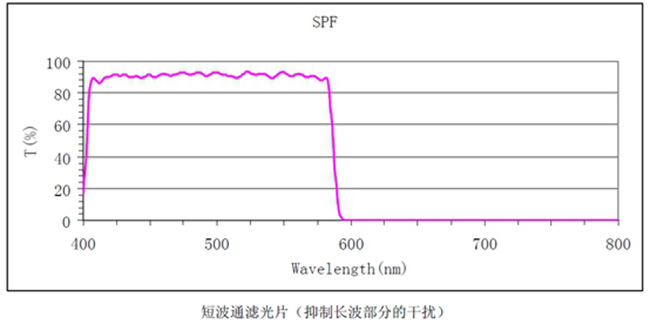
Example of transmittance curve:
Production process:
A、 Cutting: Cut the glass substrate according to the required size of the equipment, and use colorless glass substrate as the glass substrate;
B、 Cleaning: Soak the cut glass substrate in pure water and use ultrasonic waves for oscillation cleaning;
C、 Drying: Use air drying method to dry the cleaned glass substrate;
D、 Plating the main film: The ion beam assisted electron beam evaporation coating process is used to deposit the main film;
E、 Plating secondary film: After plating the main film, use the same process as in step D to plate the secondary film on the other side of the glass substrate;
F、 Post processing: Use an inner circle cutting machine to grind the edges of the coated glass substrate. Through a series of scientific manufacturing processes, the signal-to-noise ratio of machine vision filters has reached a level of 1000:1.
Application fields:
1、 Based on facial recognition, various visual access controls, attendance, door locks, storage cabinets, password protection, fatigue driving discrimination, etc;
2、 Management and traffic management based on license plate recognition.
3、 Automobile four-wheel alignment based on optical measurement;
4、 Laser ranging;
5、 Intelligent household appliances, such as automatic intelligent sweeping robots, vacuum cleaners, etc;
6、 Select superior and inferior crops (such as automatically selecting inferior peanuts and broad beans);
7、 Large screen multi touch interaction (teaching demonstration, game interaction, etc.);
8、 Monitoring of landslides along the railway coast;
9、 Monitoring of road conditions on highways.
Product advantages:
1、 Accurate wavelength positioning and strong adaptability to the environment.
2、 Good OD depth, up to 0.1% or less
3、 The filter is very thin. Different glass substrate thicknesses can be selected according to usage needs, such as 0.2mm, 0.3mm, 0.55mm, 0.7mm, and 1.1mm.
4、 The cost of mass production is low.
5、 Provide technical support or solutions related to the product.