UHC Light Damage Filter - Astronomical Observation Filter
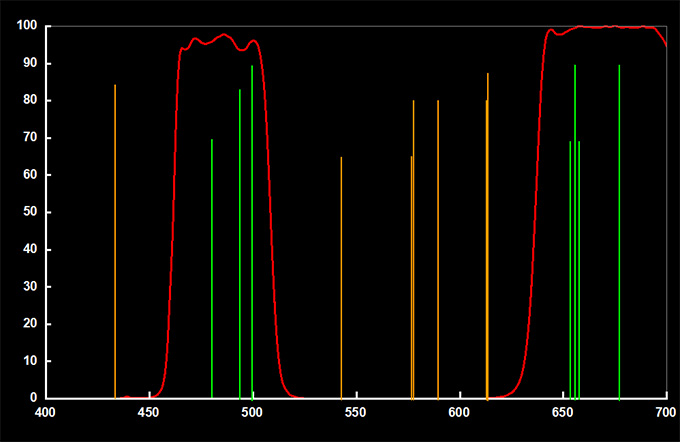
Filters are generally called filters in photography and astronomical observations, abbreviated as UHC filters. UHC filters are the abbreviation for Ultra High Contrast Filters in English and belong to the broadband filters in the astronomical filter series. UHC selectively blocks certain harmful wavelengths of light, especially artificial light (including mercury and sodium) and natural sky glow, allowing useful light emitted by nebulae to pass through efficiently. This filter is used in OIII (496nm and 500nm), Hβ The transmittance near the frequency bands of (486nm), NII (654nm and 658nm), Ha (656nm), and SII (672nm) is extremely high, effectively preventing (0.1%) harmful light from the urban high-pressure Na (589nm) Hg (578nm) and other bands. Selective filtering of urban harmful light allows it to pass through the emission spectral lines of the nebula, effectively improving the contrast of the nebula, paying attention to brightness, and reproducing rich details of the nebula.
Under what circumstances is UHC filter applicable
1. Suitable for places with severe light pollution, such as in cities, urban light pollution filters can effectively suppress harmful light in cities, thereby improving the contrast of shooting targets.
2. Suitable for use with DSLR and color CCD, suitable for DSLR cameras without modification to display emission nebulae (red), a typical nebula is the M42 Orion Nebula.
UHC filter production process:
Double sided coating, non adhesive filter, can effectively improve transmittance and cut-off depth;
Double sided polishing of the substrate to ensure parallelism above 30; High flatness effectively eliminates halos;
Electronic gun evaporation technology;
Ion source assisted coating, with good film density, can effectively reduce the drift of filter wavelength caused by temperature rise;
The metal frame is made of high-quality aviation aluminum, precision CNC integrated molding, professional fine sandblasting and anodizing treatment, and matte treatment inside the frame to prevent reflection.
Transmittance Explanation: The transmittance of important emission lines in nebulae is over 95% (such as H-Alpha, OIII, SII, H-Beta).
Cut off:>OD3 (0.1%) for light damage points such as Na: 589nm, Hg: 578nm/435nm, etc.
Glass material: Schott, Germany
Surface smoothness: 60/40
Spectral curve:
Under what circumstances is UHC filter applicable
1. Suitable for places with severe light pollution, such as in cities, urban light pollution filters can effectively suppress harmful light in cities, thereby improving the contrast of shooting targets.
2. Suitable for use with DSLR and color CCD, suitable for DSLR cameras without modification to display emission nebulae (red), a typical nebula is the M42 Orion Nebula.
UHC filter production process:
Double sided coating, non adhesive filter, can effectively improve transmittance and cut-off depth;
Double sided polishing of the substrate to ensure parallelism above 30; High flatness effectively eliminates halos;
Electronic gun evaporation technology;
Ion source assisted coating, with good film density, can effectively reduce the drift of filter wavelength caused by temperature rise;
The metal frame is made of high-quality aviation aluminum, precision CNC integrated molding, professional fine sandblasting and anodizing treatment, and matte treatment inside the frame to prevent reflection.
Transmittance Explanation: The transmittance of important emission lines in nebulae is over 95% (such as H-Alpha, OIII, SII, H-Beta).
Cut off:>OD3 (0.1%) for light damage points such as Na: 589nm, Hg: 578nm/435nm, etc.
Glass material: Schott, Germany
Surface smoothness: 60/40
Spectral curve: