Product Detail
Astronomy Filters
Custom Order
 15112422758
Call / Send specs for a quote
Custom to Drawing or Sample
Send us wavelength, size and coating specs — or a drawing or sample — and we will evaluate and issue a proposal. Prototype samples in 3-7 working days.
Scan to chat with us
Technical Specifications
| Model | RUICCN-UHC1.25 |
|---|
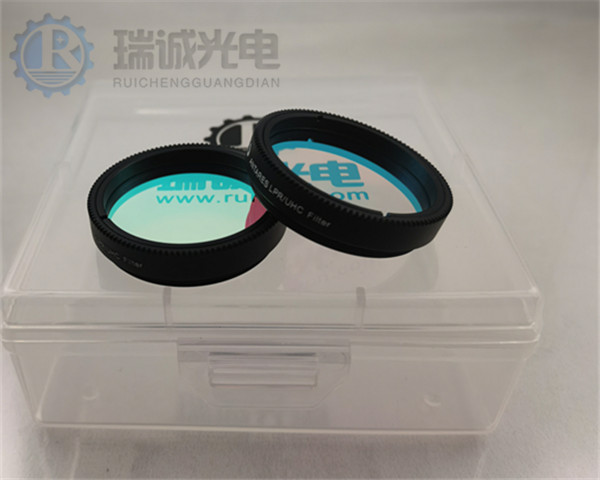
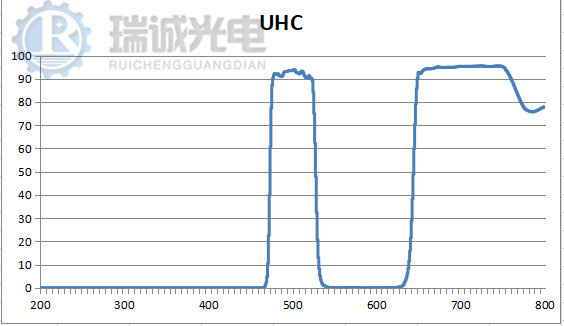
optical filterIn photography and astronomical observation, it is generally called a filter, abbreviated as a filter. UHC filter is an abbreviation for Ultra High Contrast Filters in English, which belongs to the broadband filter series of astronomical filters. UHC light filter selectively blocks certain harmful wavelengths of light, especially artificial light (including mercury light, sodium light) and natural sky gray light, allowing useful light emitted by nebulae to pass through efficiently. This filter is available in Hβ The transmittance near the frequency bands of (486nm), OIII (496nm, 500nm), NII (654nm, 658nm), Ha (656nm), and SII (672nm) is greater than 95, effectively preventing (transmittance of 0.1%) harmful light from the urban high-pressure Na (589nm) Hg (578nm) and other bands. The emission spectral lines of the nebula that selectively filter out harmful light from the city and pass through it effectively improve the contrast of the nebula, but not brightness.
Applicable situations and precautions for UHC filters
Suitable for places with severe light pollution, such as in cities, urban light pollution filters can effectively suppress harmful light in cities, thereby improving the contrast of shooting targets; In addition, it is suitable for use with DSLR and color CCD, and is suitable for DSLR cameras that have not been modified to display emission nebulae (red). A typical nebula is the M42 Orion Nebula.
Notes:
Filters increase the contrast of nebulae rather than brightness;
Filters make nebulae easier to see, but if the light pollution is too heavy, the visual effect will not improve much because after filtering out harmful light, the contrast is increased, making nebulae easier to see;
Observing different targets with different filters requires selecting different astronomical filters based on different levels of light pollution;
Filters cannot prevent all light pollution, such as car headlights still being broadband light sources, which cannot effectively prevent it.
Our company's UHC filter production process:
The substrate that has undergone precision polishing has good parallelism and surface accuracy. Double sided precision grinding and polishing can effectively eliminate halo;
Adopting a single-chip filter can maximize transmittance and cutoff depth;
The film layer has good density and adopts ion plating technology to effectively reduce the drift of the filter wavelength caused by temperature rise;
The metal frame is made of high-quality aviation aluminum alloy material, and the inside of the frame is treated with extinction to prevent reflection.
Technical Parameters:
Transmittance: The transmittance of important emission lines in nebulae is over 96%.
Cut off: For light damage points such as Na: 589nm, Hg: 578nm/435nm, etc., the cut-off is greater than OD4 (0.01%)
Glass material: Schott, Germany
Surface smoothness: 40/20
Actual measured spectral curve:
Applicable situations and precautions for UHC filters
Suitable for places with severe light pollution, such as in cities, urban light pollution filters can effectively suppress harmful light in cities, thereby improving the contrast of shooting targets; In addition, it is suitable for use with DSLR and color CCD, and is suitable for DSLR cameras that have not been modified to display emission nebulae (red). A typical nebula is the M42 Orion Nebula.
Notes:
Filters increase the contrast of nebulae rather than brightness;
Filters make nebulae easier to see, but if the light pollution is too heavy, the visual effect will not improve much because after filtering out harmful light, the contrast is increased, making nebulae easier to see;
Observing different targets with different filters requires selecting different astronomical filters based on different levels of light pollution;
Filters cannot prevent all light pollution, such as car headlights still being broadband light sources, which cannot effectively prevent it.
Our company's UHC filter production process:
The substrate that has undergone precision polishing has good parallelism and surface accuracy. Double sided precision grinding and polishing can effectively eliminate halo;
Adopting a single-chip filter can maximize transmittance and cutoff depth;
The film layer has good density and adopts ion plating technology to effectively reduce the drift of the filter wavelength caused by temperature rise;
The metal frame is made of high-quality aviation aluminum alloy material, and the inside of the frame is treated with extinction to prevent reflection.
Technical Parameters:
Transmittance: The transmittance of important emission lines in nebulae is over 96%.
Cut off: For light damage points such as Na: 589nm, Hg: 578nm/435nm, etc., the cut-off is greater than OD4 (0.01%)
Glass material: Schott, Germany
Surface smoothness: 40/20
Actual measured spectral curve: