Product Detail
Notch & Negative Filters
Related Products
- NF633-25 Bandstop Negative Notch Filter
- NF533-17 bandstop negative notch filter
- NF488-15 notch band blocking negative filter
Custom Order
 15112422758
Call / Send specs for a quote
Custom to Drawing or Sample
Send us wavelength, size and coating specs — or a drawing or sample — and we will evaluate and issue a proposal. Prototype samples in 3-7 working days.
Scan to chat with us
Technical Specifications
Specifications for this model are coming soon — call us for measured data.
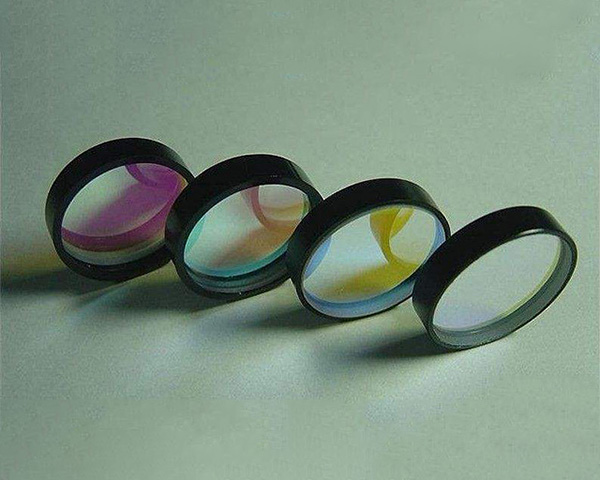
A notch filter, commonly known as a suppression filter or a band stop filter, is a type of filter that can pass through most wavelengths with almost no loss, while attenuating light in a specified band (stopband) to a relatively low level. They are exactly the opposite of bandpass filters, which have high transmittance within the bandpass range and high interception outside the bandpass range, so they can only transmit light within a very small wavelength range.
Compared to the application of laser emitting light, notch filters are quite important. In spectral experiments, it is crucial to suppress the pump laser in order to achieve a good signal-to-noise ratio. This can be achieved by placing a notch filter on the detection channel. In addition to spectrometers, notch filters are often used in laser based fluorescence instruments and biomedical laser systems.
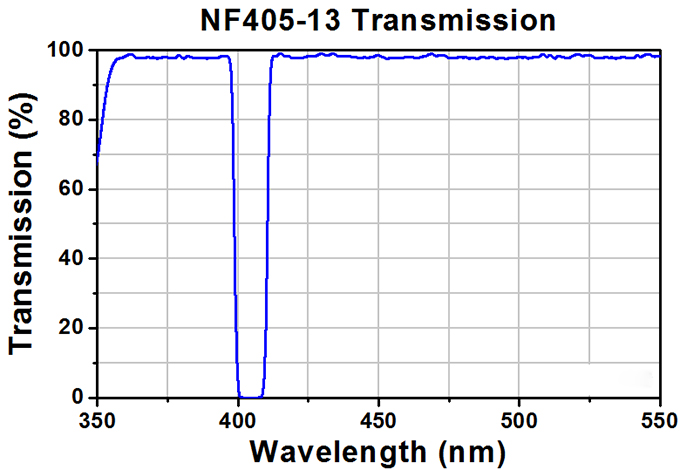
Like all dielectric stack filters, the transmission and incident angle of notch filters are related. The center wavelength of the stopband region will shift to a shorter wavelength as the incident angle increases. The transmittance curve label provided by Ruicheng Optoelectronics shows the data of transmittance and wavelength..
Ruicheng Optoelectronics' notch filter is made by depositing a dielectric film on a polished glass substrate, which has excellent environmental stability. The dielectric film reflects light in the stopband region through interference cancellation, thereby providing high blocking efficiency; The optical density within the stopband is greater than 6.0 (corresponding to a transmittance of less than 0.0001%). The filter we currently provide can be selected with a center wavelength of 405, 488, 514, 533, 561, 594, 633, 658, 785, 808, 980, or 1064 nm. Regardless of which filter is chosen, the wavefront error of the transmitted beam under vertical incidence is less than half of the wavelength at 633 nm. These filters are coated with an anti reflective film on the back to ensure an average transmittance of over 90% within the passband range.
Each filter is installed in an aluminum ring that has undergone oxidation and blackening treatment, with arrows indicating the design direction of light propagation. This aluminum ring is easy to access and enhances the blocking light density by limiting scattering. They can be installed in our filter holder and filter wheel. Due to the lack of threads on these mounting brackets,Ø is required for installation; Install the filter in the SM1 lens sleeve with internal threads using a 1-inch snap ring. We do not recommend removing the filter from its mounting ring as it may damage the filter. But we also offer uninstalled and customized size filters; For more details, please contact technical support.
In addition to the commonly used center wavelength, our company can also customize the center wavelength and bandwidth according to the actual needs of customers.
In addition to the commonly used center wavelength, our company can also customize the center wavelength and bandwidth according to the actual needs of customers.