Collimator and beam expander
Collimators are designed for point light sources, which are common in our daily lives, such as the light emitted by lighting a match or the light bulb of an old-fashioned flashlight. For laser systems, the collimating mirror we are discussing is essentially the laser generated from the energy transmission fiber.
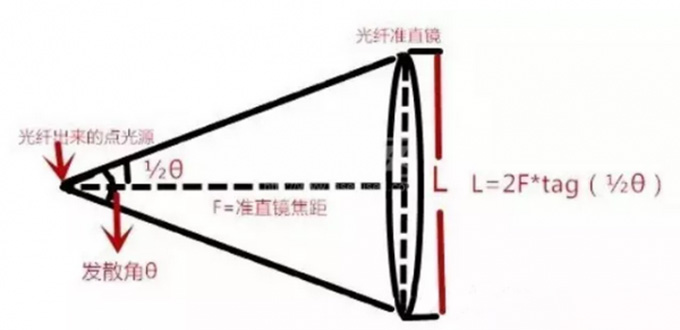
The light from the energy fiber is a point light source with a divergence angle. If we place this light source at the focal point of the fiber optic collimator, we will know that the light emitted from the focal point of the collimator (actually using the collimator in reverse) will become parallel light after passing through the collimator.
So what is the diameter of the beam after passing through the collimating mirror? The answer is: 2f * tag (1/2 * theta;). If the divergence angle is 10 degrees, f=150 mm, The diameter of the beam coming out of the collimator is 2 * 150 * tag (5 degrees)=26.2466mm. This formula has important reference significance for the selection of welding machine galvanometers.
Continuing with the knowledge points of the fiber cutting laser cutting machine industry: After the laser is collimated, it enters the focusing mirror of the fiber cutting machine. Let's give an example to illustrate more intuitively, for example, the focal length of the collimating lens is 75mm, the focal length of the focusing lens is 150mm, 75÷ 150=1/2, which means that the area of the focused spot after passing through the focusing mirror is twice as large as the area of the point light source just coming out of the energy fiber, and the energy density is half of the original.
Why do we need to lower the energy density? Isn't it better to concentrate energy density? There are several main reasons:
Firstly, if the focal length of the focusing lens is short, the focal length of the focusing lens is shallow, and the depth of focus is shallow, it can easily lead to deep cutting.
Secondly, the shorter the focal length, the smaller the focal point, the smaller the slit, and the smaller the weld seam, which is not conducive to the detachment of cutting slag and leads to cutting. So we usually try to use a focal length of 120 to 150 millimeters to make the focusing lens for fiber optic cutting machines. Additionally, why don't we use long focal length collimators? One of the reasons is that for long focal length fiber collimators, a larger lens diameter is required, which can lead to cumbersome mechanical design. The focus of the fiber cutting machine is very sensitive, and once the focal length deviates, cutting phenomena will occur. That's why the focus of our regular fiber optic cutting machine is usually between 60 and 100 millimeters.
beam expander
The beam expander also has the function of collimation, but it is aimed at the beam. The lasers on the Chinese market mainly include CO2 glass tubes, CO2 RF tubes, YAG lasers, QBH fiber lasers, 355nm, 532nm, 1064nm lasers, etc. These lasers generate beams of light that are not strictly parallel. As is well known, beam extenders can increase the waist radius. In terms of profession, it is to expand the waist radius, and the product of waist radius and divergence angle is a fixed value, while increasing the waist radius (i.e. beam expansion) reduces the divergence angle (achieving collimation). The conclusion is that after passing through an N-fold beam expander, the divergence angle of the laser beam is reduced to one-third of the original N. For example, after four times beam expansion, the divergence angle decreases to 1/4 of its original value. That's why we use beam expanders as much as possible.
The beam expander includes: CO2 expander, 532nm expander, 355nm expander, 1064nm expander, and 650nm expander.
Collimators include: collimating mirrors for fiber laser cutting machines and collimating mirrors for fiber laser welding machines.